Why BalaneDisk never deletes anything
A cleaner that empties folders unasked is asking for trust with data it does not understand. We took the opposite route — measure, explain, and hand the lever over.
The first decision in this project was a refusal: BalaneDisk gets no delete button. No "Clean all", no progress bar that ends with 32 GB gone. That sounds like a missing feature. It is the feature.
What a tool actually knows about a folder
Measuring a directory is easy. du walks it and reports a number. What du can never say is how much of that number comes back for free. A 14 GB cache might rebuild itself in five minutes — or hold the only copy of a database someone created by hand two years ago.
That difference is not in the file system. It is in the tool that owns the folder.
So BalaneDisk asks the tool instead of measuring the folder:
docker system df -vDocker answers with four separate accounts — images, containers, local volumes, build cache — and says itself which of them is reclaimable. That answer is worth more than any estimate made from outside.
The difference one flag makes
The same answer produces the second rule: never suggest the blanket command.
| Command | What it really does |
|---|---|
docker system prune | clears what is already orphaned |
docker system prune -a | also removes the images of stopped containers |
docker volume prune | deletes anonymous volumes |
docker volume prune -a | deletes the hand-named ones too — usually data |
A single flag separates tidying up from losing data. An app that hides that difference under a button labelled "Clean" has made the decision that belongs to the person in front of it. BalaneDisk shows both commands, staged, and names what each one takes with it.
Where we deliberately do not guess
Docker does not distinguish between an image pulled from a registry and one built here. The first is a download; the second may be half a day of work. Because the tool does not know, the display does not pretend to: the finding reads "look first" rather than "safe".
That is uncomfortable. Claiming a certainty that does not exist would be more comfortable — and it is exactly the kind of confidence cleaning software is famous for.
The only button that moves anything
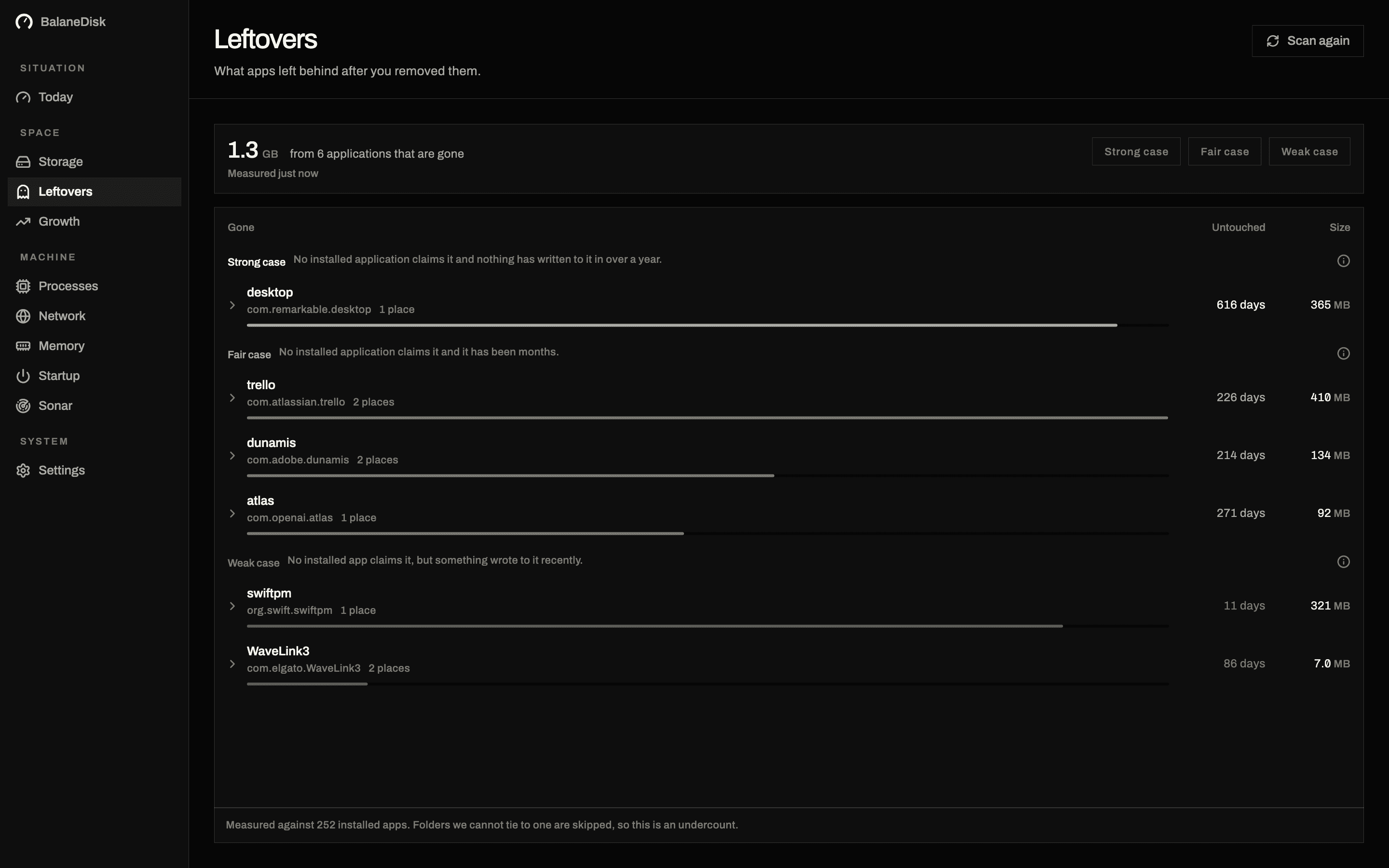
There is one exception, and it is deliberately small: the leftovers of applications you removed can be moved to the Bin. Not deleted — moved. The Bin is the one undo every computer user already knows and trusts, and the action is triggered by hand, per group, after the app has said what is in that group.
The three verdicts, and what each one commits us to
Every finding carries one of three labels, and they are promises rather than colours.
Safe to remove. Purely rebuildable, with no judgement involved. A build cache, a downloaded installer, the Bin. If we are wrong here, the cost is a re-download. We only use this label where the content is regenerable by definition, not where it merely looks like it.
Look first. The honest label, and the one a cleaner does not have. Downloads, Docker's data folder as a whole, an application's support directory — places where something regenerable and something irreplaceable sit in the same folder. This label exists because the alternative is guessing, and guessing here is how people lose work.
Leave alone. System data, snapshots, anything where the size is the operating system doing its job. Naming it at all matters: a 20 GB item you can see and understand stops being a mystery, even when the answer is "nothing to do here".
The reason we can afford to show uncertain findings at all is precisely that we do not act on them. A misjudgement costs you a glance, not data.
Why this holds on Windows too
Windows makes the same problem harder. macOS at least gives leftovers a reverse-DNS identifier that can be matched back to a bundle; Windows has no equivalent. %APPDATA%\Spotify is filed under a name a human chose, and the only things to match against are the uninstall entries in the registry:
HKLM:\SOFTWARE\Microsoft\Windows\CurrentVersion\Uninstall\*
HKLM:\SOFTWARE\WOW6432Node\Microsoft\Windows\CurrentVersion\Uninstall\*
HKCU:\SOFTWARE\Microsoft\Windows\CurrentVersion\Uninstall\*
A folder whose name matches nothing in those keys is probably a leftover. Probably is not a licence to delete. So the Windows version does the same thing the Mac version does: it shows the folder, its size, the program it thinks it belonged to, and a confidence score — and it stops.
The same applies to processes. On Windows, a binary is judged by its Authenticode signature, not by its file name, because a name is the one property an attacker controls completely. An unsigned executable calling itself a system component from the wrong folder is the finding; deleting it is not our call to make.
What follows for liability
This position is not only editorial. Software that deletes nothing can delete nothing wrongly. A misjudgement in our matching costs you a glance, not your data. That in turn lets us search harder and report more honestly: we can show a finding we are 70 % sure about, because the cost of being wrong is a raised eyebrow rather than a support ticket.
A cleaner that deletes has to search conservatively. An instrument that measures is allowed to be curious. We picked the instrument.
Next: Docker is eating your Mac's disk · Mac storage full: where the gigabytes hide · A CleanMyMac alternative that doesn't clean anything · What your Mac is really doing
Questions people ask
- How do I clean up if the app deletes nothing itself?
- Through the route the finding carries: either the owning tool's command (`docker builder prune`, `brew cleanup`) in the terminal, or the folder the app opens in Finder. Leftovers move to the Bin at the press of a button — somewhere you can get them back from.
- Are cleaning apps dangerous?
- Deleting is not the danger; deleting without knowing the contents is. A tool that files a 40 GB folder as "cache" while named Docker volumes sit inside it has made a decision it is not equipped to make.
- What happens if BalaneDisk matches a file wrongly?
- Nothing. A misjudgement costs you a glance, not data — which is exactly why we are allowed to show findings we are not fully certain about and label them "look first".