macOS · Windows · Version 0.2.1
See what your computer is really doing.
Twelve gigabytes went overnight — BalaneDisk names the folder that took them. Every process explained, every outgoing connection resolved to the company receiving it, and a cleanup that moves nothing you have not ticked.
Free, no account, nothing leaves the machine
Three promises
01
Nothing is uploaded
No file contents, no folder names, no telemetry. The country and tracker databases ship inside the app, because a tool that asked a server which trackers you talk to would be handing over the very list it exists to protect.
02
Nothing moves unasked
BalaneDisk measures and explains. What it clears is what you ticked, it goes to the Bin, and emptying the Bin is a second button with its own warning on it.
03
Nothing is invented
Every figure on screen is a measurement. Where there is no measurement, the screen says so instead of printing a plausible zero.
New in this version
Where did the space go?
Every disk tool on both platforms answers what is large today. None of them answers the question people actually ask: it was fine yesterday — what took twelve gigabytes overnight. Growth keeps the difference between measurements instead of photographing the disk, so it can name the folder that grew while nobody was watching.
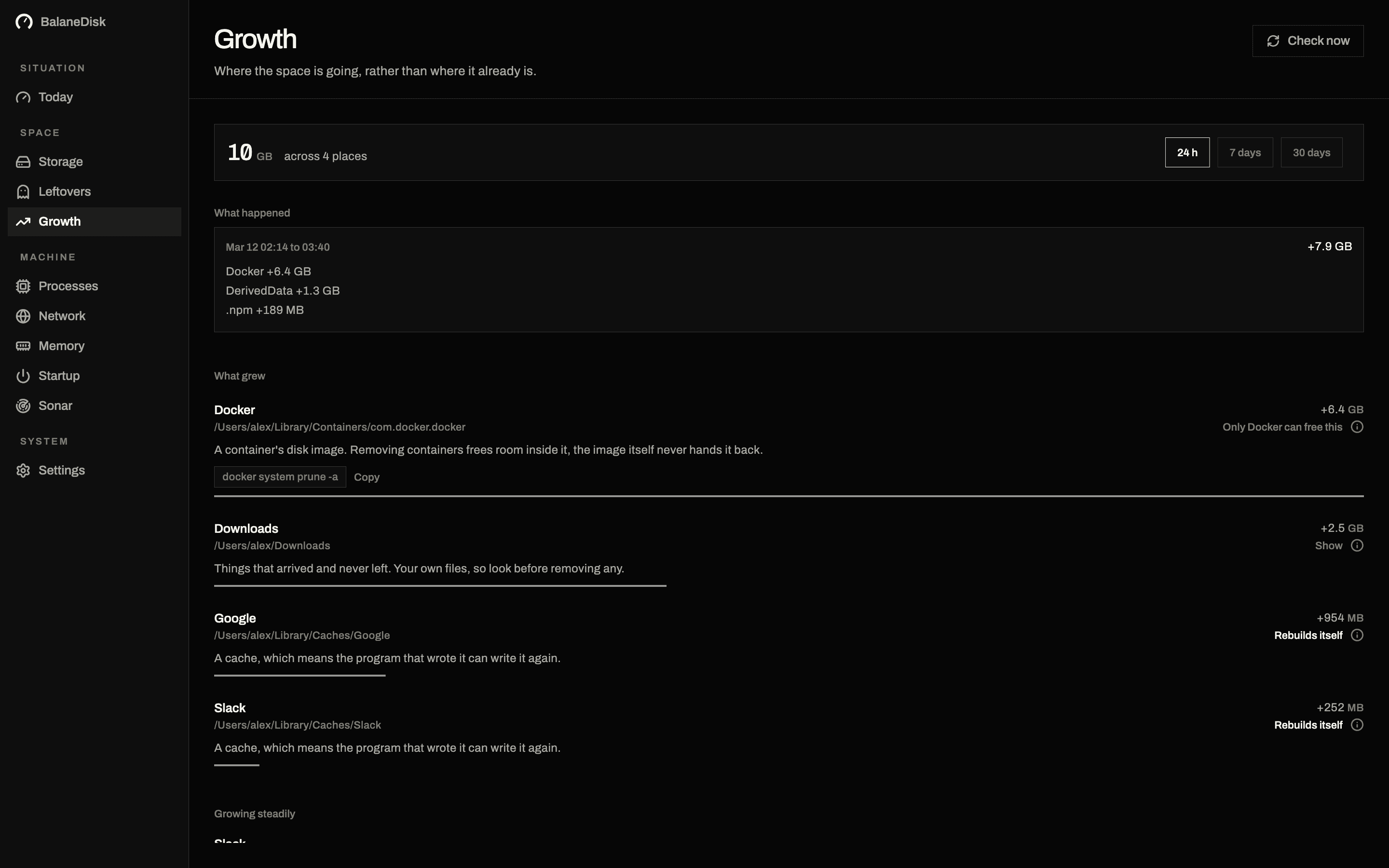
What happened
- DockerOnly Docker can free this+6.4 GB
- DerivedDataRebuilds itself+1.3 GB
- .npmRebuilds itself+189 MB
- 01
It names the hour, not just the folder. A window of ninety minutes with three folders in it is a thing you can remember doing.
- 02
Each place carries what it costs to get back: rebuilt for free, handed back only by the tool that made it, or your own files, which are nobody's to clear.
- 03
The first pass only writes down what is there. From the second on, this screen is about change — which is why it says so rather than showing an empty chart.
The habit
Ninety seconds, once a week.
Every other screen reports a condition, and a condition cannot be finished. The round can: three checks, one morning a week, and an ending that says you are done. It is the only place in the application where somebody is told they have completed something.
01
What grew
The places that have come on since the last round, largest first.
02
What can go
Only what is already on your cleanup list, with today's size beside each entry.
03
What is new at startup
Anything that has added itself to what this machine starts by itself.
The ending
That is this week's round — the fourth in a row.
Leaving early is free and leaves no mark: the round is only written down when the last card is reached. Pick the day, or turn it off entirely; it never speaks in between.
What it finds
On an ordinary machine, this is what turns up.
Typical findings on a working computer after a year or two. The sizes are the ranges we keep seeing on test machines, not a promise — BalaneDisk measures yours and tells you the real number, along with what it costs to get each one back.
| Finding | Typical size | Verdict |
|---|---|---|
Xcode build data and device support Rebuilt on the next build. The single largest finding on most Macs that compile anything. | 10–60 GB | Safe |
Docker images, volumes and build cache Asked of Docker itself, split into four accounts — because a named volume is a database and an unused image is a download. | 5–80 GB | Look first |
Package manager caches (npm, pub, Homebrew, pip) Purely re-downloadable, and the places that fill up again fastest — which is what puts them on the cleanup list. | 2–15 GB | Safe |
iOS simulators and old device backups Every simulator carries its own data. Backups may be the only copy of a phone that no longer exists. | 5–40 GB | Look first |
Leftovers of applications you removed Grouped by the dead application, with a confidence score. Moved to the Bin only when you press the button. | 0.5–8 GB | Look first |
Processes running from a temporary folder Usually an installer or a build tool. Occasionally the thing you would want to know about within the hour. | 0–13 | Worth reading |
Every screen
The whole instrument.
Real screenshots, rendered from the application itself. The machine in them is invented and unwell in the ways the product exists to catch — a private home folder says more about a person than a marketing picture is worth.
Situation
Space
Machine
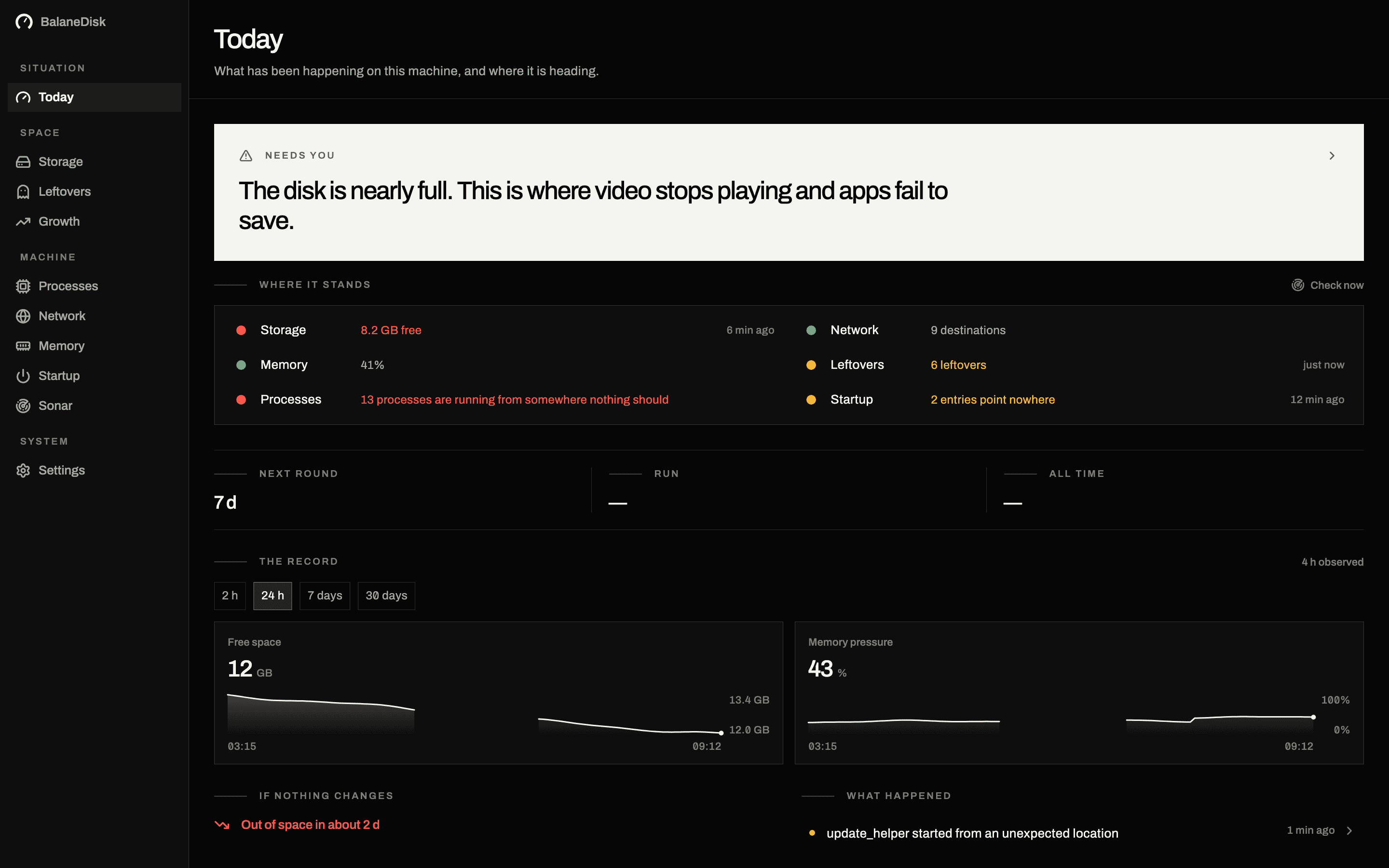
Today
What has been happening on this machine, and where it is heading.
One rating and one sentence, then six areas with the age of each reading beside them. Under that the record: free space, memory pressure and process count over hours or days, a straight-line forecast, and every incident since the app was installed.
What you get out of itKnow whether anything is wrong before you have read a single figure.
Look at your own machine first.
Everything BalaneDisk finds, it finds for free — on both platforms, with no account.
The first screen
Six parts of a machine, read at a glance.
An instrument shows figures and leaves the judgement to you. BalaneDisk opens on one sentence about the worst thing it knows — and under it, where each part of the machine stands and when that was last established. One button runs the lot: disk, memory, processes, network, leftovers, startup, in the order that decides which one stops you working first.
All quiet
Nothing needs you. The app says so and stops talking.
Keep an eye
Something moved. Not urgent, but worth knowing.
Needs you
The disk is nearly full, or a process is running from somewhere nothing should.
Not measured yetAn area nobody has looked at gets a grey dot and the words to match. A green dot for something unmeasured is the one lie this panel could tell.
The record
Free space
12GB
Memory pressure
43%
Processes
1,482
If nothing changes
Out of space in about 2 d
A straight line through the last measurements — deliberately a line and not a model, so you can check it against the curve above it.
What happened
- update_helper started from an unexpected location1 min ago
- Free space dropped below a tenth23 min ago
- Memory pressure rose1 hr ago
Only transitions are recorded, never every reading over a threshold. Repetition buries the moment it is trying to report.
How the sonar works
The beam brings the finding.
Marks do not all refresh together every three seconds. A new process appears, and a finished one disappears, when the sweep passes its bearing — the way a real sonar only knows what its last pass told it. The circle is cut into four sectors that never overlap, so a mark's direction means something before its colour does.
- System
- Shipped with the operating system.
- Applications
- Things you opened.
- Background
- Helpers, agents, updaters.
- Elsewhere
- Running from somewhere unusual.
Distance from the centre is memory held. Click any mark to read what it is.
Every process, judged
Signed, unsigned, or somewhere it should not be.
Three colours, and they are the only colours in the application. Everything else — every panel, every chart, every heading — is paper, ink and one grey between them, which is exactly what makes a single amber dot findable from across a desk. The verdict is never colour alone: each one carries a word and an icon as well.
Verified
Signed by the system or a publisher we recognise.
Unverified
Signed, but we cannot vouch for the publisher yet.
Suspicious
Unsigned, or running from somewhere it should not be.
Suspicious is not the same as malicious — build tools and installers look exactly like this. It is the short list worth reading. Verdicts survive a restart: each one is filed against the size and date of the file it judged, and thrown away the moment either changes.
The rule that shapes the product
Two presses, and both of them are yours.
A cleaner that empties folders unasked is asking for trust with data it does not understand. So BalaneDisk measures, explains what a finding is, and then hands over the lever — and where it does clear up, it does it in two steps that you take, in the open.
- 01
A folder only joins the cleanup list because you put it there. Suggestions come from what has actually filled up again on this machine, and ticking one adds a name to a list — nothing else.
- 02
Every clearing shows you each entry and its size first, and moves them to the Bin. The Bin sits on the same disk, so nothing is freed yet — which the screen says, rather than claiming a number it has not earned.
- 03
Emptying the Bin is a separate button with a warning on it, because that is the step that cannot be undone. It is also the step that gives the space back.
- 04
Never the blanket command.
docker system prune -aalso removes the images of stopped containers; one flag separates tidying up from losing data, and the app names the difference instead of hiding it. - 05
Nothing outside your home folder can go on the list, and places that look like real data are refused outright — with a sentence saying why.
What leaves this machine
Two requests. That is the whole list.
A tool that reports what your computer talks to has no business being chatty itself.
Checking your licence
Your key and this computer's name, so one licence stays on one computer. Nothing else is attached.
Asking for updates
Whether a newer version exists. The answer is a signed file; nothing about you goes with the question.
Never: what you have
No file contents, no folder names, no process list, no addresses. The GeoIP and tracker databases are bundled and read from disk, so lookups happen on your machine or not at all.
Never: who you are
No account, no sign-in, no analytics, no crash pings. An unpaid copy makes no requests at all.
How it differs
Four tools, four different jobs.
The category is crowded, but almost nothing overlaps. This is what each kind of tool is actually built to do.
| BalaneDisk | Cleaner apps | Network monitors | Built-in tools | |
|---|---|---|---|---|
| Names what took the space since yesterday | Yes | No | No | No |
| Explains each process in plain language | Yes | No | No | No |
| Resolves connections to company and country | Yes | No | Yes | No |
| Finds what removed applications left behind | Yes | Yes | No | No |
| Records history and names the incident | Yes | No | Partly | No |
| Clears only the folders you ticked, to the Bin | Yes | No | — | Partly |
| macOS and Windows | Yes | Partly | Partly | Yes |
| Works without sending anything anywhere | Yes | No | Partly | Yes |
Categories, not individual products, and written from what each kind of tool sets out to do. Judge ours against yours — the free version finds everything the paid one finds.
Price
Everything it finds is free. The subscription is the part that works while the window is shut.
Nothing BalaneDisk knows is behind a gate. A free copy runs every scan, reads every verdict, keeps a week of record and clears up once a week. What money buys is frequency, scale and being told the morning something happens instead of at the end of the week.
The line used to run through knowledge — everything found, shown to everyone, and a month of record instead of two hours. Two hours is not enough record for a chart to be a chart, so the free copy had nothing to come back to. Now the line runs through how often and how much.
Free
0 €for as long as you use it
- Every screen: Today, Growth, Storage, Leftovers, Processes, Network, Memory, Startup, Sonar
- Every finding, every verdict, every explanation — nothing is held back
- Seven days of record, incidents and charts
- One watched folder, and one clearing a week
- Every kind of notification, gathered into one a week
BalaneDisk Pro
Both plans, same product24,99 €a year
Saves 58 % against monthly. 7 free days first — cancel during them and nothing is charged.
Start 7 free days4,99 €a month
No trial on this plan, and no year to commit to. Cancel from your own account whenever you like.
Subscribe monthly- 30 days of record instead of 7
- Told the morning it happens, rather than once a week
- Watch as many folders as you like, instead of one
- Clear up whenever you want, instead of once a week
Both plans unlock exactly the same thing. Activating sends your key and this computer's name, and nothing else.
- Sold through Lemon Squeezy — proper invoice, EU VAT handled
- Not billed through a store: the subscription lives in your own account
- No account here: a key, pasted into the app
- One computer per licence, and you move it yourself
Nothing starts recording when you pay. This computer has already measured that past — the subscription opens the part of it you cannot see yet.
Get it
One download. No account.
Signed and notarised for macOS, built for Windows from the same code. It starts measuring the moment it opens — no setup screen, no empty dashboard with a button on it.
Version 0.2.1
Questions
The ones worth asking.
Does it delete anything?
Not on its own, and never behind your back. A folder reaches the cleanup list because you put it there; every clearing shows you each entry and its size before it moves anything; and what it moves goes to the Bin. Emptying the Bin is a separate button with its own warning, and that is the only step that destroys anything. Everything else — caches, build data, the leftovers of applications you removed — is measured, explained, and handed to you as a command or a folder.
What is new in this version?
Growth, which names what took the space since yesterday rather than what is large today; the weekly round, which is three checks and about ninety seconds; a cleanup list you build yourself, cleared to the Bin one press at a time; and folders you can ask to hear about when they grow past a size you set. The whole interface was redrawn in Balane's own language at the same time: no accent colour, one typeface, square corners, and hue reserved for the three verdicts.
What does it need access to?
On macOS, Full Disk Access, so it can measure the folders that actually fill up; the app explains why before the system asks. On Windows, elevation for the deeper counters. Everything it reads is measured and shown on your screen, and nothing is sent anywhere.
Is there a Windows version?
Yes — the same code base, built on Windows for Windows, and the two are kept in step screen for screen. It is in the Microsoft Store, which installs and updates it for you; a direct ZIP is published alongside each release for machines without the Store. The macOS build is signed and notarised.
Do I need an account?
No. The free version asks for nothing. A subscription gives you a key you paste into the app, which activates it for one computer — and you can release that computer yourself at any time.
Does it have to stay running?
It is worth it. The record of the last days only exists if the app was there to take it, so closing the window puts BalaneDisk back in the menu bar or tray instead of quitting. A quiet machine shows just the mark, with no text beside it.
Which languages does it speak?
Eight: English, German, French, Spanish, Italian, Portuguese, Dutch and Japanese — including the plain-language explanation of each process, which is the part no comparable tool localises.